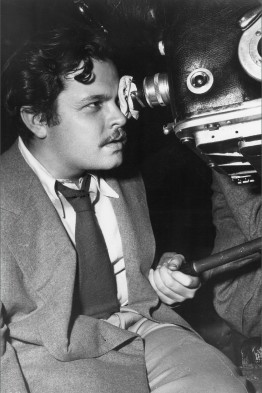
Biography
Arguably one of the most influential film directors of all-time, Orson Welles mastered multiple media during his impressive fifty year career. Welles, who died at age 70 in 1985, is best remembered for his innovative work in radio, theater, television and film. His 1938 broadcast of H.G. Wells’ The War of the Worlds and 1941 film Citizen Kane, which he co-wrote, produced, directed and starred in, are among the memorable creative works of the 20th century.
His work is still relevant today as researchers, scholars and fans continue to study his oeuvre and pay tribute including two 2018 documentaries: Mark Cousin’s The Eyes of Orson Welles and Morgan Neville’s They’ll Love Me When I’m Dead (both used materials from our collections). That same year, Netflix financed the completion of his previously unfinished film, The Other Side of the Wind. (which drew upon documents from the Welles collections to aid in the films reconstruction).
Overview of the Archive
U-M is home to the most extensive international collection of archives on Welles. The collections, some seven in total, include thousands of documents, letters, telegrams, scripts, production and financial statements, photographs, illustrations and audiovisual materials and cover all areas of his creative output. There is also a substantial amount of material of a personal nature including recently acquired letters Welles sent to his beloved guardian, Dr. Maurice “Dadda” Bernstein.
The collection totals nearly 100 linear feet, including thousands of documents, letters, telegrams, scripts, production and financial statements, photographs, illustrations and audiovisual materials. The Orson Welles Collections consist of different collections:
- The Welles-Feder Collection, from Chris Welles Feder, Welles’ oldest daughter, who provided many personal materials.
- The Beatrice Welles Collection, from Welles’ youngest daughter, which includes signed correspondence, scrapbooks and scripts.
- The Welles-Kodar Collection, from Oja Kodar, Welles’ partner/collaborator, which includes scripts, production documents and photographs.
- The Wilson-Welles Collection, from Chris Wilson, son of producer Richard Wilson, who provided materials stored in the family garage for decades.
- The Welles-Tasca Collection, reflecting the working and personal relationship with producer Alessandro Tasca di Cuto.
The Welles Collections at the University of Michigan Library are a major research destination for scholars and filmmakers alike. A few examples include:
- The completion of “The Other Side of the Wind” Welles’s final unfinished film, which was ultimately released on Netflix in 2018. Read How Orson Welles’s “The Other Side of the Wind” Was Rescued from Oblivion published by the New Yorker in September 2018.
- “They’ll Love Me When I’m Dead”, Morgan Neville’s 2018 documentary released on Netflix as a companion to “The Other Side of the Wind”.
- “The Eyes of Orson Welles”, a film by Mark Cousins which celebrated its earned Special Distinction in the Golden Eye documentary competition during its World Premiere at the 2018 Cannes Film Festival.
- “Rebooting Studies of Film Authorship by Curating in the Classroom at Michigan,” was co-authored by professor Matthew Solomon, curator Philip Hallman and student Vincent Longo, and published in Cinema Journal: The Journal of the Society of Cinema & Media Studies Teaching Dossier: Teaching with Primary Sources Vol 4 (3).
- BROADCAST HYSTERIA: Orson Welles’s War of the Worlds and the Art of Fake News, the 2015 book by A. Brad Schwartz and published by Hill & Wang is based on the groundbreaking research conducted as part of his senior honors thesis at the University of Michigan. Brad also co-wrote a 2013 episode of the PBS series American Experience about the War of the Worlds broadcast, based in part on his thesis research.
- It’s All True: Orson Welles’s Pan-American Odyssey, the 2007 book by Professor Catherine Benamou published by the University of California Press.
Welles Symposium
The University of Michigan hosted “Wellespring: A Centenary Celebration of the Inexhaustable Inspiration of Orson Welles” in June 2015 in conjunction with the Cinetopia International Film Festival. Speakers included U-M Professor Matthew Solomon and Welles scholar and professor Catherine Benamou, Chris Wilson, and Oja Kodar. Read more by Wellesnet founder Jeff Wilson here.
More on Orson Welles
Buckley, C. (2017, April 24). Orson Welles’s Diaries and Scripts Head to Archive. New York Times.
Hinds, J. (2015, June 7). Orson Welles looms large at Cinetopia, U-M symposium. Detroit Free Press.
Schwartz, A.B. (2015, April 27). Orson Welles and History’s First Viral-Media Event. Vanity Fair.
Browse the Screen Arts Makers & Mavericks Finding Aids at the University of Michigan Library’s Special Collections Research Center.
 Screen Arts Mavericks & Makers